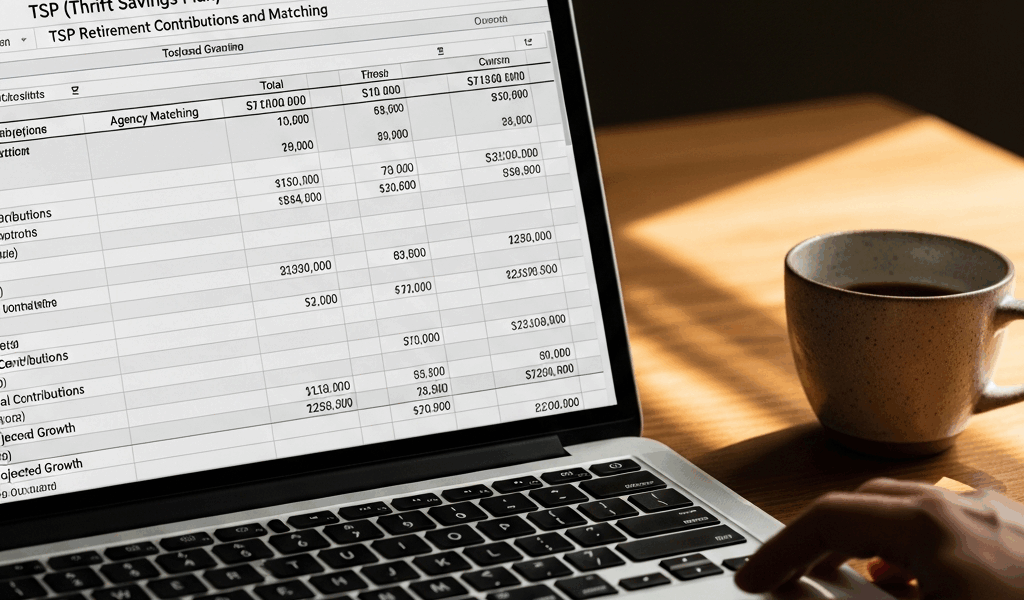
DoD will put free money into your TSP account every pay period — up to 5% of your base pay — and you don’t have to do anything special to earn it beyond contributing to your own account. Yet roughly 25% of service members under the Blended Retirement System don’t contribute enough to get the full match. That’s thousands of dollars in guaranteed returns left on the table every year.
Here’s exactly how the matching works, the contribution percentage you need to hit, and how to set it up so you never miss a dollar.
How DoD TSP Matching Works
Under the Blended Retirement System, DoD contributes to your TSP in two ways:
Automatic 1%: DoD puts 1% of your base pay into your TSP every pay period regardless of whether you contribute anything. You don’t have to opt in. You don’t have to contribute a single dollar of your own money. This 1% is automatic and begins after 60 days of service.
Matching contributions up to 4%: For every dollar you contribute up to 5% of your base pay, DoD matches a portion. The match structure is tiered:
Your contribution of 1% = DoD matches 1%. Your contribution of 2% = DoD matches 2%. Your contribution of 3% = DoD matches 3%. Your contribution of 4% = DoD matches 3.5%. Your contribution of 5% = DoD matches 4%.
Add the automatic 1% on top of the match. At 5% contribution, you get: 5% (yours) + 1% (automatic) + 4% (match) = 10% of your base pay going into TSP every pay period. That’s a 100% return on your 5% contribution before any investment growth.
The Dollar Amount: What This Actually Means
An E-5 with 6 years of service earns roughly $3,700/month in base pay. At 5% contribution:
Your contribution: $185/month ($2,220/year). DoD automatic 1%: $37/month ($444/year). DoD match: $148/month ($1,776/year). Total going into TSP: $370/month ($4,440/year).
You put in $2,220 and get $2,220 from DoD. Over 20 years of service with promotions and pay raises, the DoD contributions alone — not counting investment growth — total roughly $80,000-$120,000. Add compound growth at 7% average annual returns and the matching contributions alone could be worth $150,000-$200,000 by retirement.
If you contribute 3% instead of 5%, you leave roughly $800-$1,200 per year in unmatched funds. Over a 20-year career, that’s $16,000-$24,000 in missed matching — and $40,000-$60,000+ in missed growth. For a 4-year enlistment, it’s still $3,200-$4,800 in matching you’ll never get back.
How to Set Your Contribution to Get the Full Match
Log into myPay (mypay.dfas.mil). Navigate to TSP contributions. Set your contribution to at least 5% of base pay. That’s the magic number — anything above 5% still goes into your TSP but won’t generate additional matching from DoD.
You can contribute more than 5% if your budget allows — the 2026 annual TSP contribution limit is $23,500 for traditional/Roth combined. But for matching purposes alone, 5% is the target. Going from 0% to 5% is worth more than going from 5% to 15% because the first 5% generates an additional 5% from DoD.
Roth TSP vs Traditional TSP: Quick Decision Framework
DoD matching contributions always go into your Traditional TSP — you don’t get a choice on the match. But your own contributions can go into either Traditional (pre-tax) or Roth (after-tax).
For most junior enlisted and company-grade officers, Roth TSP is the better choice. You’re in a low tax bracket now — likely 12% or 22% federal. Your military income is partially sheltered by BAH and BAS exclusions. Paying taxes now at 12-22% and withdrawing tax-free in retirement (when your income and tax rate may be higher) is a favorable trade.
For senior NCOs and field-grade officers in the 24%+ bracket, Traditional TSP may make more sense — you defer taxes now at a higher rate and potentially pay lower rates in retirement. Run the numbers for your specific situation, but the default recommendation for junior service members is Roth.
The Bottom Line
Contribute at least 5% to your TSP. That’s the minimum to capture every matching dollar DoD will give you. If you can afford more, go higher — but the first 5% is the non-negotiable baseline because it’s the only contribution range where someone else doubles your money automatically.
Every pay period you spend below 5% is money you can’t recover. The matching is use-it-or-lose-it — there’s no retroactive catch-up. Set it to 5% today, adjust your budget around it, and let compound growth do the rest over your career.




Stay in the loop
Get the latest dod retire.com updates delivered to your inbox.