“`html
Why Your CRSC Back Pay Is Held Up
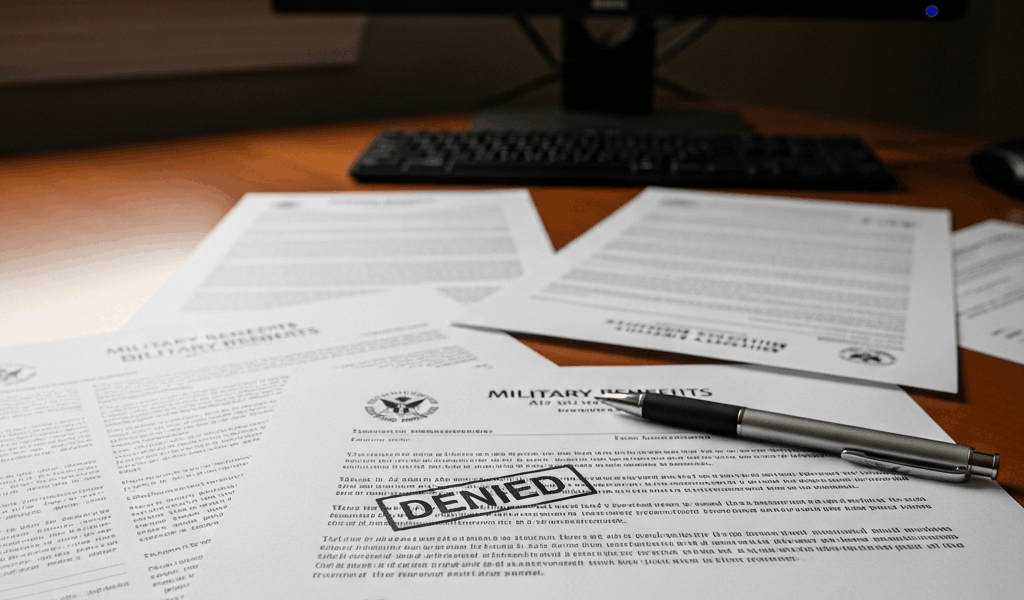
CRSC back pay denial has gotten complicated with all the misinformation flying around — but honestly, it’s almost always one of five specific problems. I learned this the hard way after spending six months chasing a DFAS verification letter that nobody told me I needed.
The most common hold-up? Incomplete DFAS verification. Here’s what happens: DFAS (Defense Finance and Accounting Service) must confirm your military pay records before the VA can authorize CRSC payments. Rejected by DFAS matching? Everything stalls. I’ve seen this delay payments by 8 to 12 weeks alone. You need a Letter of Verification from DFAS showing your service dates, rank, and final base pay — call them directly at 1-800-321-1080. Don’t wait for the VA to ask for it. Send it proactively with your appeal. That’s the move that actually works.
Second issue: concurrent receipt recomputation. If you were receiving Concurrent Retirement and Disability Pay (CRDP) when you applied for CRSC, the VA must recalculate what you’re owed. CRDP stops the moment CRSC is approved. The math gets messy fast, and the VA often miscalculates on the first attempt. Take 2022 — a Navy retiree from San Diego was denied CRSC back pay of $14,400 because the VA’s initial computation failed to account for his CRDP offset period. He resubmitted with a line-by-line recalculation showing month-by-month what he’d received under CRDP versus what he should receive under CRSC. Approval came in 34 days.
Third: missing combat-related injury documentation. The VA needs proof your disability is combat-related, not just service-connected. Medical evidence alone won’t cut it — you need either a Combat Zone Imminent Danger Pay (CZIP) record or a Statement in Support of Claim (VA Form 21-0781a) from you describing the actual combat incident. Probably should have opened with this one, honestly. Most people submit their disability rating letter and assume that’s proof. It isn’t. The VA will reject it and send you back to gather military records proving you were in a designated combat zone during your injury date.
Fourth: tax withholding documentation gaps. If you elected federal tax withholding on your CRSC payments, the VA needs W-4 forms or written withholding instructions. Missing this paperwork holds everything for 4 to 6 weeks while they hunt you down. File a new W-4V (Voluntary Withholding Request) the moment you submit your appeal — don’t wait.
Fifth — and this catches almost 15% of applicants — you’re actually ineligible for CRSC because you qualify for CRDP instead, and your claim got processed under the wrong program. More on this below, but it’s why understanding the eligibility split matters before you even appeal.
How to File a CRSC Appeal on VA Form 21-0958
VA Form 21-0958 is the Notice of Disagreement. It’s three pages, and each section has specific demands.
Section 1: Identify your denial. Write the exact issue number from your denial letter. Can’t find your original? Log into VA.gov and download it from your Letters and Documents section. You need that specific rating decision number.
Section 2: State your disagreement. Keep this to two sentences. Say: “I disagree with the denial of CRSC back pay dated [date]. I am submitting additional documentation that supports my eligibility.” That’s it. Don’t write a manifesto — the VA doesn’t read them.
Section 3: The attachments. Most appeals fail right here. Include:
- Copy of your original CRSC application (VA Form 21-8940)
- Your denial letter
- DFAS Letter of Verification (discussed above)
- Combat zone documentation (CZIP records or signed statement explaining why your disability is combat-related)
- Any new medical evidence since the denial
- W-4V form if tax withholding was an issue
- A signed cover letter listing every document enclosed, with page count
Mail the complete packet to: Department of Veterans Affairs, Regional Office, Attn: Evidence Intake Center, [your regional office address]. Find your specific address at va.gov/regional-offices. Request certified mail with delivery confirmation — this matters. The VA processes these in 30 to 60 days. Don’t expect faster.
Track receipt by calling your Veterans Service Center 7 to 10 days after mailing. Have your claim number and Social Security number ready. Ask them to confirm the appeal packet arrived and what documents they see in the file. This single step prevents the nightmare of a “lost” submission.
The One Phone Call That Speeds Up Your Case
After you file the appeal, one strategic phone call often cuts processing time in half.
Call the Veterans Service Center for your region. Find the number at va.gov or call the main VA line at 1-800-827-1000 and ask for your regional office. Have these ready: your claim number, SSN, date of your original CRSC application, and the denial date.
Use this script: “I filed a CRSC appeal on [specific date]. I’m calling to confirm all required documents were received and to verify what’s currently in the file. Can you walk me through what you see?” Then listen. The representative will list every document they have. This is gold. If something’s missing, they’ll tell you right then, and you can overnight it.
What not to do: Don’t express anger. Don’t demand a timeline. Don’t say “this is ridiculous.” Veterans Service Center staff process hundreds of claims monthly. Professionalism gets you information. Aggression gets you a case closure letter.
The hard statistic here: approximately 30% of CRSC denials are reversed on appeal because the initial submission lacked a single clarifying document — often something nobody told the applicant was required. That phone call finds the missing piece before 60 days of waiting gets wasted.
Fast-Track Option: Hire a VA-Accredited Representative
Hiring a representative doesn’t speed up the VA’s internal timeline. What it does speed up is your information gathering and submission quality, which matters more than you’d think.
Cost structure: VA-accredited representatives charge a contingency fee of 20% of your approved back pay, capped at $6,000. So if you’re owed $30,000, the rep takes $6,000. If you’re owed $15,000, the rep takes $3,000. If you’re owed $4,000, they take $800. Some people balk at this. I understand. But here’s the actual math: representatives typically get responses in 4 to 6 weeks because they know exactly what documents to submit and format appeals correctly on the first pass. Pro se appeals (filed by you alone) average 8 to 12 weeks because the VA often sends Requests for Evidence asking for clarification on documents you already provided.
The free alternative exists: Veterans Service Officers. Every state has them. They work through your state veteran’s agency or local veteran’s service organizations (American Legion, VFW, etc.). They charge nothing and can file appeals on your behalf. The trade-off? They handle more cases and may not have time for deep case review. But if your appeal is straightforward — just one missing document — a VSO is your move. If your case involves recomputation, multiple disabilities, or prior denials, a paid representative earns their fee.
Decision rule: Hire a rep if you’re owed more than $10,000 and your appeal requires substantial documentation gathering. If you’re owed $4,000 or less, use a free VSO and save the fee.
CRSC vs. Concurrent Retirement and Disability Pay — Know the Difference
As someone who’s reviewed dozens of denied CRSC claims, I learned that the most common frustration is this: “I was denied CRSC, but the letter didn’t explain why or mention that I might qualify for something else.”
CRSC and CRDP are mutually exclusive. You get one or the other, not both. The VA should screen your eligibility for both automatically. Often they don’t — or they do and the explanation gets buried in dense rating decision language.
CRSC eligibility: Combat-related disability. You must have been injured or became ill in a designated combat zone. Your disability must be rated at least 10% by the VA. You must have military retirement pay. Meet all three? You qualify for CRSC.
CRDP eligibility: Any service-connected disability (combat or not) rated at 50% or higher. You must be a military retiree. No combat zone requirement.
The split matters: If your disability is combat-related and rated 50%+, the VA has discretion. You *could* qualify for both programs. The VA should give you CRSC — it’s the better deal because it doesn’t reduce your military retirement pay. But some regional offices misprocess and push you into CRDP instead. CRDP reduces your retirement check and replaces it with VA disability pay — usually a net loss for retirees.
Which pays faster? CRDP, typically 4 to 8 weeks from application to first payment. CRSC runs 10 to 16 weeks because DFAS verification adds delay.
Quick self-diagnosis: Were you injured in Iraq, Afghanistan, or another VA-designated combat zone between 2001 and 2014 (or during any marked conflict)? If yes, push for CRSC. Were you injured stateside or in a non-combat zone but your disability is rated 50%+? If yes, you may be locked into CRDP — which is still better than nothing, but appeal to confirm you’re not being denied CRSC unfairly.
If your initial denial letter mentions CRDP without explaining why you weren’t approved under CRSC, that’s your first appeal argument. Request a full eligibility determination under both programs, in writing, on your Form 21-0958.
“`




Stay in the loop
Get the latest dod retire.com updates delivered to your inbox.