“`html
Exchange Access After DoD Civilian Retirement Stays or Goes
I spent twelve years as a DoD civilian in acquisition, and the email I got on my last day of work made me panic. It said my exchange card would be “deactivated upon separation.” Nobody had explained what that actually meant, and I assumed I’d lose access to the BX immediately. Turns out, the real story was way more complicated—and honestly, most DoD civilians get this wrong.
Exchange access after retirement has gotten complicated with all the conflicting information flying around. The short answer? Most of you keep it. But eligibility depends entirely on your retirement type and whether your dependent ID card is still valid. That’s what makes understanding these rules endearing to retirees—it’s the difference between accessing tax-free shopping and getting turned away at the gate on your first day of separation.
The exchange (BX at Air Force bases, PX at Army/Space Force, NEX at Navy installations) is the on-base retail store where you shop tax-free. The commissary is the grocery store with subsidized pricing. Both are separate systems with different rules post-retirement. But what is the actual difference in your access? In essence, one requires continuous dependent validation while the other grants lifetime eligibility in some cases. But it’s much more than that.
Let me give you the quick reference breakdown:
| Retirement Type | Exchange Eligibility | Commissary Eligibility |
| FERS (Federal Employees Retirement System) | Yes—if dependent ID valid | Yes—if dependent ID valid |
| CSRS (Civil Service Retirement System) | Yes—if dependent ID valid | Yes—if dependent ID valid |
| Early Retirement (Rule of 87) | Yes—pending RAPIDS update | Yes—pending RAPIDS update |
| Disability Retirement | Yes—lifetime access | Yes—lifetime access |
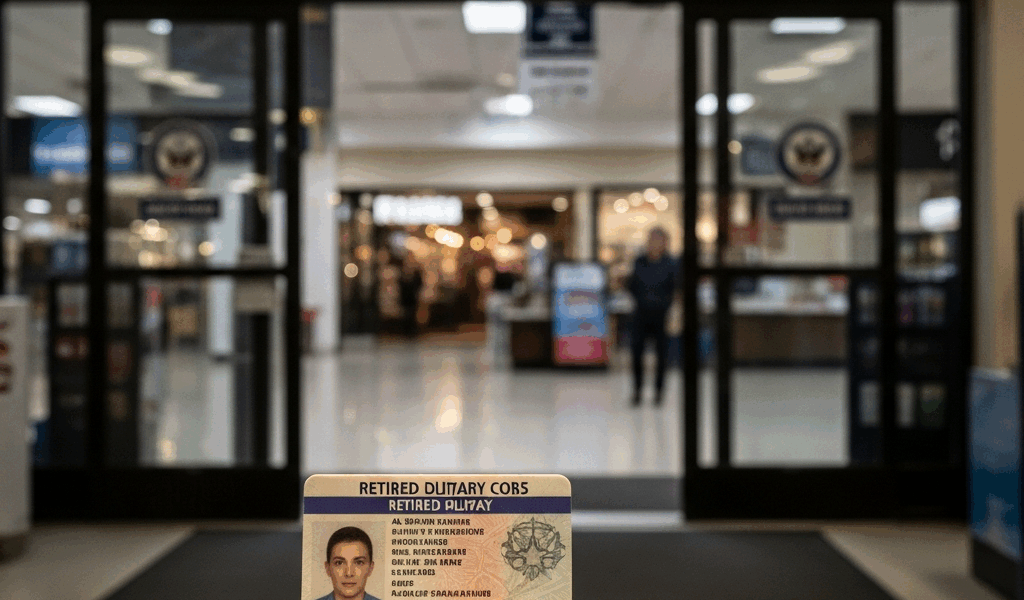
The critical detail nobody mentions: your dependent ID card is the key. If your spouse’s or child’s ID expired before your civilian retirement processed, you lose access immediately—even with valid retirement orders. This is the #1 reason cards get declined at the gate. That 1996 email I mentioned? Still the standard warning civilians get today.
Why Your Exchange Card Might Stop Working Immediately
Denied by the gate scanner on week one of retirement. It happens more than you’d think, and I’ve watched it happen to people standing right behind me in line.
Four specific scenarios kill access post-retirement. Walk through yours:
Scenario 1 — Dependent ID Expired Before Your Separation Date
Your spouse’s military ID expired six months before you retired. Frustrating, sure—but you thought that was fine since you’d update everything after your last day. Wrong approach. The system checks dependent ID validity at gate swipe. If the card isn’t showing as active in DEERS, the scanner rejects you. Your retiree status doesn’t matter if your dependent can’t validate you’re authorized.
The fix here is straightforward: don’t wait. Book a RAPIDS appointment before your separation date if you know your dependent ID is expiring soon. Cost is zero. Typical appointment wait is 2–4 weeks at most installations, though some bases move faster.
Scenario 2 — DEERS Not Updated with Your Retirement Status
You officially retired. Personnel gave you separation orders dated March 15th. But DEERS—the Defense Enrollment Eligibility Reporting System—still shows you as “active duty” in the system. When gate security runs your retiree ID, the database says you’re not eligible yet. Access denied, even though your paperwork says otherwise.
I watched this happen to a colleague. His retirement orders were filed locally but hadn’t synced to the central DEERS database for three weeks. He was technically retired but the system didn’t know it. Spent an entire week thinking he’d lost his privileges permanently.
The fix: Call your installation’s personnel office. Ask them to manually verify your separation was recorded in DEERS. Get a confirmation number. This usually takes 24–48 hours to sync across the system.
Scenario 3 — Your Retiree Status Isn’t Recognized at the Gate
You’re swiping a retiree ID card, but the gate scanner says “Unknown cardholder.” The card looks fine. Issue date, expiration—all current. But the system has no record of you. That’s because the ID was issued before your retirement processed, so it was printed with your old rank and “active duty” status. The system doesn’t recognize a card with conflicting data.
The fix: Go directly to the RAPIDS office (not the gate). Bring your retirement orders. Request a manual lookup and a new ID card reflecting retiree status. Takes about 10 days to print and mail.
Scenario 4 — You’ve Relocated Away from Your Original Installation
Retired from Eglin AFB but moved to Sacramento? Try using the BX at Travis AFB and you’ll hit a wall. The gate says your authorization is tied to Eglin only—access denied at another installation. This is rare but happens when your ID card was coded with a single-base restriction, which some installations do to track civilian access.
The fix: Contact the RAPIDS office at your new duty station with your retiree ID and orders. Request a “multi-base” or unrestricted authorization. Usually approved same-day.
Step-by-Step Verification Process at the Commissary Entrance
You’re at the gate. Your card won’t scan. Here’s exactly what to do, in order.
Step 1: Ask for a Manual Verification. Tell the gate guard: “My card won’t scan—can you run a manual lookup?” Give them your full name and Social Security number. They have a computer behind the gate. Most installations can pull up your record in 2–3 minutes, and you’ll either be in or you won’t.
Step 2: If the Lookup Succeeds. You’re cleared. This confirms you’re in the system and eligible. The issue is just your card hardware. You don’t need to leave—go ahead and shop.
Step 3: If the Lookup Fails. The guard will likely say, “You’re not showing as retiree-eligible. You need to go to RAPIDS.” Write down the exact reason they give you—it helps immensely when you call.
Step 4: Call RAPIDS Immediately. Don’t wait days. Your installation’s RAPIDS office handles all ID card and eligibility issues. Find the number by googling “[Your Base Name] RAPIDS appointment.” Most installations have online scheduling now. Example: Lackland AFB’s RAPIDS is +1 (210) 925-1533, and they’re typically available 8 AM to 4 PM Monday through Friday.
What to bring to RAPIDS: your retirement orders (original or certified copy), a state ID or passport, and your current retiree card even if it’s not scanning. Don’t show up empty-handed—they’ll turn you away.
Step 5: Schedule a Same-Day or Emergency Appointment if Possible. Most RAPIDS offices offer expedited slots for new retirees. Explain you just separated and lost access to necessary services. They often squeeze you in same-day.
Step 6: Expected Timeline. Manual verification at the gate (if successful): immediate. RAPIDS appointment request to actual appointment: 3–7 days standard, or same-day if available. New ID card printing and mail delivery: 10–14 business days. Replacement cards are free.
Probably should have opened with this section, honestly—so many retirees don’t know they can ask for a manual lookup and think one failed card swipe means permanent access loss.
Dependent ID Renewal and What Happens If Yours Expired
This is the scenario that blindsides retirees most often, and I’m apparently one of the people who gets caught off guard by it.
Your spouse’s military ID expired on February 28th. You’re retiring March 1st. You assumed the ID would automatically renew once you were officially retired. It doesn’t work that way—an expired ID is expired, regardless of your new status. You lose access until it’s renewed. Don’t make my mistake and assume the system handles this automatically.
Here’s what you need to know:
The RAPIDS Process for Renewal
Schedule an appointment at RAPIDS. Bring: your spouse’s expired ID card, a state ID (spouse’s or yours), marriage certificate (original or certified copy), Social Security card, proof of residence (utility bill dated within 90 days), and your retirement orders. RAPIDS will issue a new dependent ID on the spot or within 2–3 business days. No fee.
If You Need Expedited Renewal
Call ahead and explain: “My dependent ID expired before my civilian retirement separated. I need emergency access to the commissary.” They’ll prioritize you. Turnaround can be same-day at some installations.
Cost and Timeline
Renewal: free. Standard appointment wait: 1–3 weeks. Expedited appointment: 24–48 hours. Card printing: same-day or next-business-day at most bases.
If Your Dependent ID Lapsed More Than 2 Years Ago
It’s still renewable, but RAPIDS may ask for additional documents like a DD Form 1172 (Application for US Military ID Card) to verify current dependent status. Bring everything listed above.
Commissary vs Exchange Privileges Are They the Same After Retirement
People use the terms interchangeably. They’re not the same thing, and post-retirement rules treat them slightly differently.
The Exchange (BX/PX/NEX)
This is the retail shopping area—tax-free status for all authorized patrons. Typical savings run 10–15% compared to civilian retail. You’ll find clothing, electronics, household goods, and more. You need a valid military ID to enter and make purchases.
The Commissary
This is the grocery store. Prices run 5% below comparable civilian grocers, which is a huge difference on a full shopping trip—roughly $50–80 per month for a family of four. But commissary access is more restricted post-retirement than exchange access. Probably should have been clearer about that upfront.
Post-Retirement Eligibility Breakdown
FERS and CSRS retirees get both commissary and exchange. Rule of 87 retirees get both, pending RAPIDS update. Disability retirees get both, indefinitely. Survivor Benefit Plan recipients get commissary only, unless they have a military ID through another eligibility category. The critical difference: if your dependent ID expires, you lose both. But if you have a retiree ID only (no spouse or dependent), you typically keep exchange access but may have restricted commissary access depending on your retirement category—check with your installation’s personnel office about your specific situation.
Your takeaway: get that dependent ID renewed before it lapses. That’s the linchpin of your entire post-retirement access.
“`



Stay in the loop
Get the latest dod retire.com updates delivered to your inbox.